Most visitors to Buenos Aires will end up taking a taxi at some point. We explain how to avoid the scams an unscrupulous minority of taxi drivers employ.
While the subtes (subway system) and colectivos (buses) are more economical and quite simple to get the hang of, the convenience and speed of the taxis can’t be beat. The Buenos Aires taxis are easy to flag down and more economical than in major US or European cities. So, for short term visitors who don’t want to bother learning the public transportation system, taxis are probably going to be your best bet.
The majority of taxi drivers are hard working people just trying to make an honest living. Most will be happy to chat with you about anything from the weather to futbol to crooked politicians. All of them seem to speak with a messianic certainty while doling out their opinions. However, there are always a few assholes in the bunch who look to hoodwink unassuming passengers.
So before you hop in the next taxi, be aware of the common scams those few, yet menacing, taxi drivers might attempt. As with most crimes in Buenos Aires, taxi drivers usually don’t blatantly rob you, but are rather subtly opportunistic (kind of like Wall Street bankers). If you are speaking a foreign language, have an accent, or are visibly inebriated, it is more likely the driver will try to pull a fast one. Location also matters. If you hail down a taxi in front of the Recoleta Cemetery, after a tango show, or stumbling out of a club, taxi drivers will smell an easy tourist and/or drunk victim.
Using Uber may help you avoid some of these scams. However, thanks to their shaky legal status in Argentina, taking Ubers comes with its own set of issues.
Scam #1 counterfeit change
.
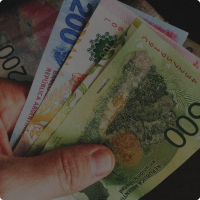
Always try to pay the driver with a small bill. Never use a $1,000. Most taxi drivers don’t have the appropriate amount of change. If they do, they may give you fake pesos back as change. Before exiting the taxi, always hold the bill up to the light and check for the security thread and watermark. See Counterfeit Money in Argentina for a visual example. Most of the time, it isn’t so hard to tell the difference. A lot of fakes look like they were simply scanned and printed off an ink jet printer. The taxi drivers will usually give you another bill if you object to the one they give you. The best way to prevent receiving fake change is to give the driver the closest to exact change as you can. Leaning forward and showing them you are paying attention is also a good habit to create.
Scam #2 – The old switcheroo.
You would think that some drivers are also part-time magicians from their slight of hand. Another very common scam involves the driver exchanging your real bill with a fake bill. For example, you give the driver a real $50, he fumbles around a bit up front and then proceeds to give you back a fake $50 claiming you gave him a fake bill. I know people who have been taken for several $100 peso bills with this trick, so be careful! The best way to prevent this scam is to always check your bills before paying the driver. If you are sure he did the old switcheroo, call him out on it and just leave. But, I emphasize, be sure that your bill is real before paying the driver. You wouldn’t want to inadvertently screw an honest guy.
Scam #3- Wrong amount paid.
A taxi driver probably won’t try this one unless he thinks you are either really green or very drunk. If the fare comes to over $100 and you pay with a $100 and something else, the driver will claim that you gave him a $10, not a $100. To avoid this scam, say the amount out loud that you are giving him as you pay the fare. As with the switch, be sure you are paying the correct amount, so you can confidently tell the driver “anda a la ___ ” (fill in with your preferred insult.) Or tell him to call the cops to resolve the matter if you wish to be more civil, obviously he won’t.
Scam #4 – Rigged meter.
There are a few tricks taxi drivers have been known to pull using their meters. Sometimes, a driver will pretend like he forgot to turn on the meter and then make up an exorbitantly high fare when you reach your destination. So just check that the driver turns on the meter when you get in, and politely remind him to turn it on if he doesn’t after a block. Drivers have also been known to rig their meters so that they increase at a quicker rate. The meter should start at $9.10 and increase $0.91 every 200 meters during the day (10:00 pm to 6 a.m. is $10.80 with $1.80) or roughly 40 seconds if you’re in traffic. Just keep an eye on the meter, if you suspect its increasing at a faster rate than usual, just get out of the taxi at the next block and flag down another one.
Scam #5 – The scenic route.
Wherever you are in the world, if you’re visiting a new city, there is a good chance your taxi driver could take you the long way. There is nothing you can really do about it, unless you know the city. Try to give the driver a corner to drop you off at instead of an exact address. It shows you may have an idea of where you are going and helps the driver find your destination faster. Often drivers know where intersections are better than exact addresses. You can also specify the route you’d like the driver to take, if you are somewhat familiar with the city. Lastly, never tell the driver it is your first/second/third/etc. day in Buenos Aires.
Solution: Lean forward in your seat and pay attention. Your chances will greatly decrease if it is apparent that you are paying attention to what is going on. Intoxicated or distracted passengers are targeted.
All the travel guides to Buenos Aires, Argentina strongly recommend taking only Radio Taxis. Maybe they are indeed safer; in my experience though, when it comes to these common scams, Radio Taxi Drivers try to bamboozle you just as often as non Radio Taxi Drivers.
The purpose of this article is not to scare or dissuade you from using taxis. Stick-ups and “express kidnappings” are virtually unheard of in Argentina. More than likely, your next taxi driver will be a source of knowledge, entertainment and conversation. Just like any other situation, while traveling in a new city, be alert and know the game, so you are not taken for a fool.